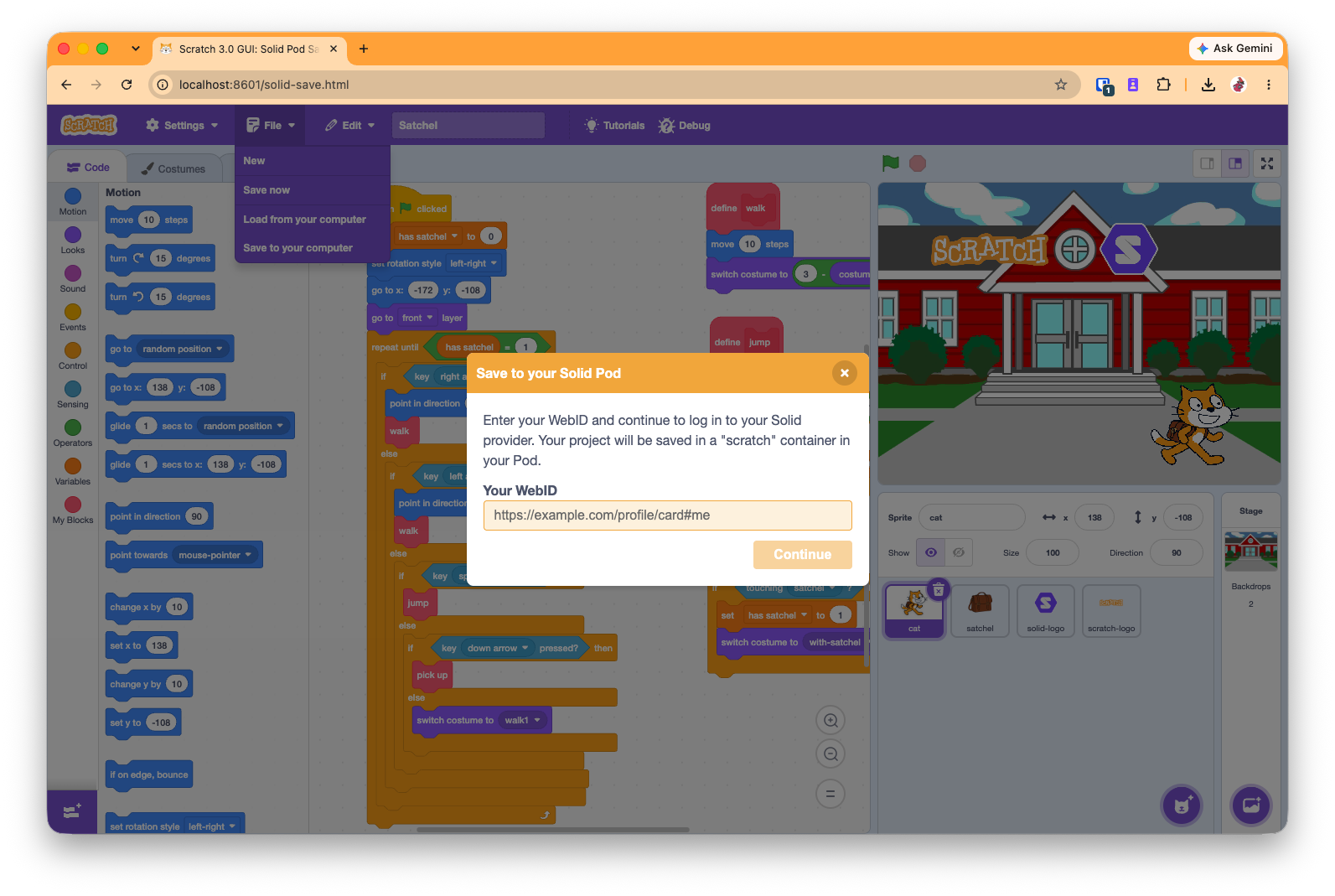
Satchel (working title) is a planned prototype that adds Solid storage to Scratch: a child’s projects are saved to their own personal Pod, instead of living only inside whichever platform hosted that day’s coding session. On top of that sits a sharing dashboard where the child and their guardian decide together who else can see a project — one project at a time, with either of them able to take it back whenever they like — replacing Scratch’s all-or-nothing “shared or not” switch. A small, replaceable agent carries out their decisions, without ever holding the children’s work or anyone’s password.

What is Scratch?
Scratch is the free, block-based coding tool millions of children use to make games and animations — but a project saved there lives only inside whichever club, school or platform's account created it.
Read more about What is Scratch?
What is Solid?
Solid is an open web standard for personal data storage: instead of every app holding its own copy of your data, you keep it in a personal online datastore called a Pod that you control.
Read more about What is Solid?
Satchel: adding Solid storage to Scratch
A prototype Scratch editor that saves a child's projects to their own Solid Pod, plus a sharing dashboard where the child and their guardian decide together who else can see them. It aims to show that children's work can be portable, and shared on the family's terms rather than a platform's.
Key features
- Portability. Projects live in the child’s own Pod, so they outlive any one club, school or platform account.
- Shared decisions. A share only happens when both the child and their guardian agree, and either can take it back at any time.
- Fine-grained sharing. Show a project to your Code Club without making it public to the world.
- Nothing held centrally. The only service Satchel runs holds none of the children’s work and no passwords, and a family can swap it for one run by someone else.
Beyond Scratch: a general principle
Scratch is the concrete tool, but the underlying pattern — a child's own, portable store of their learning work, controlled by them and their family — is meant to generalise to any tool that produces a child's learning data.
Read more about Beyond Scratch: a general principleHow this differs from previous attempts
Earlier attempts at learner-record systems, like inBloom, foundered because a single organisation held the data centrally. Solid never puts a child's data in one company's database in the first place.
Read more about How this differs from previous attemptsWhy this exists
Satchel is a proposal in response to the Open Data Institute's Solid use case open call, which offers in-kind support to non-commercial projects using Solid for social good.
Read the application